Dacia Duster - ABC Leasing
The independent Dacia Duster video review
This is a sample, and will stop after 30 seconds.
DUST TO DUST(some text hidden)
By Jonathan Crouch
Ten Second Review word count: 42
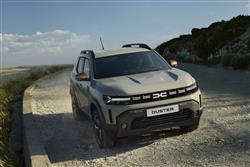
The third generation version of Dacia's Duster is a much more advanced thing. But in many ways the spirit and value of its sensible, practical small SUV predecessors still remain. Don't buy another small, lifestyle SUV until you've looked at this one.
Background word count: 209
'The best bargain on the market'. That's quite a claim isn't it, particularly for a car that starts from around £22,000. But this third generation version of Dacia's Duster SUV just might be. It's not an EV but it's the first Duster that's been in any way electrified and, thanks to use of existing Renault Group tech and cheap manufacturing in Romania and Morocco, it offers easily the best value compact family SUV proposition on the market. You could argue that the Duster always has, ever since it first arrived back in 2010. Alongside the Sandero hatch, it's been the brand's biggest seller since then, updated in second generation form in 2017 and along the way notching up 2.2 million registrations. All that's been founded on a back-to-basics approach to SUV design and a platform originally created by Renault in the '90s. A structure which of course couldn't accommodate the kind of electrified engines a car like this must now have. So this MK3 Duster adopts the same Renault Group CMF-B platform of other Dacias, a move additionally supposed to benefit practicality and refinement, though one that's also pushed the price up. But as we said earlier, the Romanian brand still thinks it's a bargain. Is it? Let's see.
Driving Experience word count: 359
The core Duster engine is a mild hybrid three cylinder 1.2-litre powerplant that features a 48V system harvesting energy into a tiny 0.9kWh battery that uses it to aid acceleration. Most customer choose this with front wheel drive, in which form there's 140hp, enough to get you to 62mph in 9.8s en route to 112mph. The mainstream alternative is the Hybrid 155 model. Here, you get a full-Hybrid 1.8-litre four cylinder powertrain offering 155hp. This combines a 109bhp four cylinder petrol engine, two electric motors (a 50hp motor and a high-voltage starter/generator), a 1.4kWh battery (280V) and an automatic electric gearbox. It has four gears for the ICE engine and two for the electric motors. Your third Duster drivetrain option is the one you'll need if you want this Dacia with AWD. The Duster hybrid 150 4x4 uses the mild hybrid three cylinder 1.2-litre powerplant, but pairs it to a rear-mounted electric motor to power the rear wheels when extra traction is needed, while the petrol engine drives the front wheels through a six-speed dual-clutch automatic gearbox. The rear motor delivers up to 87Nm of torque and is paired with an innovative two-speed gearbox, helping provide strong low-speed traction while maintaining all-wheel drive capability at higher speeds. When four-wheel-drive is no longer required, the rear axle can disengage completely to reduce friction for more efficient road driving. If grip is lost, torque can be delivered to the rear wheels immediately. Five driving modes help drivers adapt the Duster hybrid 150 4x4 to the prevailing conditions. Auto manages the switch between two- and four-wheel-drive, while Eco prioritises efficiency but can call on all-wheel-drive when needed. Snow is designed for slippery roads, Mud / Sand optimises traction on loose surfaces, and Lock supports low-speed driving on more rugged terrain. Providing additional assurance across all modes, Hill Descent Control helps maintain a consistent speed of between 2 and 18mph on steep downhill sections, while steering wheel-mounted paddles allow drivers to take manual control of the gearbox when necessary, such as when tackling particularly challenging off-road situations. Dacia claims approach and departure angles 31 and 36-degrees and up to 217mm of ground clearance.
Pictures (High res disabled)
.jpg)
.jpg)
.jpg)
.jpg)
Scoring
Category: Compact Car
| Performance | |
| Handling | |
| Comfort | |
| Space | |
| Styling | |
| Build | |
| Value | |
| Equipment | |
| Economy | 70% |
| Depreciation | 80% |
| Insurance | 70% |
| Total | 66% |
Mobile
Narrow
Narrower
Normal
Wide